
Digitize purposefully. Grow sustainably.
Not everything at once. We start where the greatest benefit arises – and expand secondFactory step by step with your business.
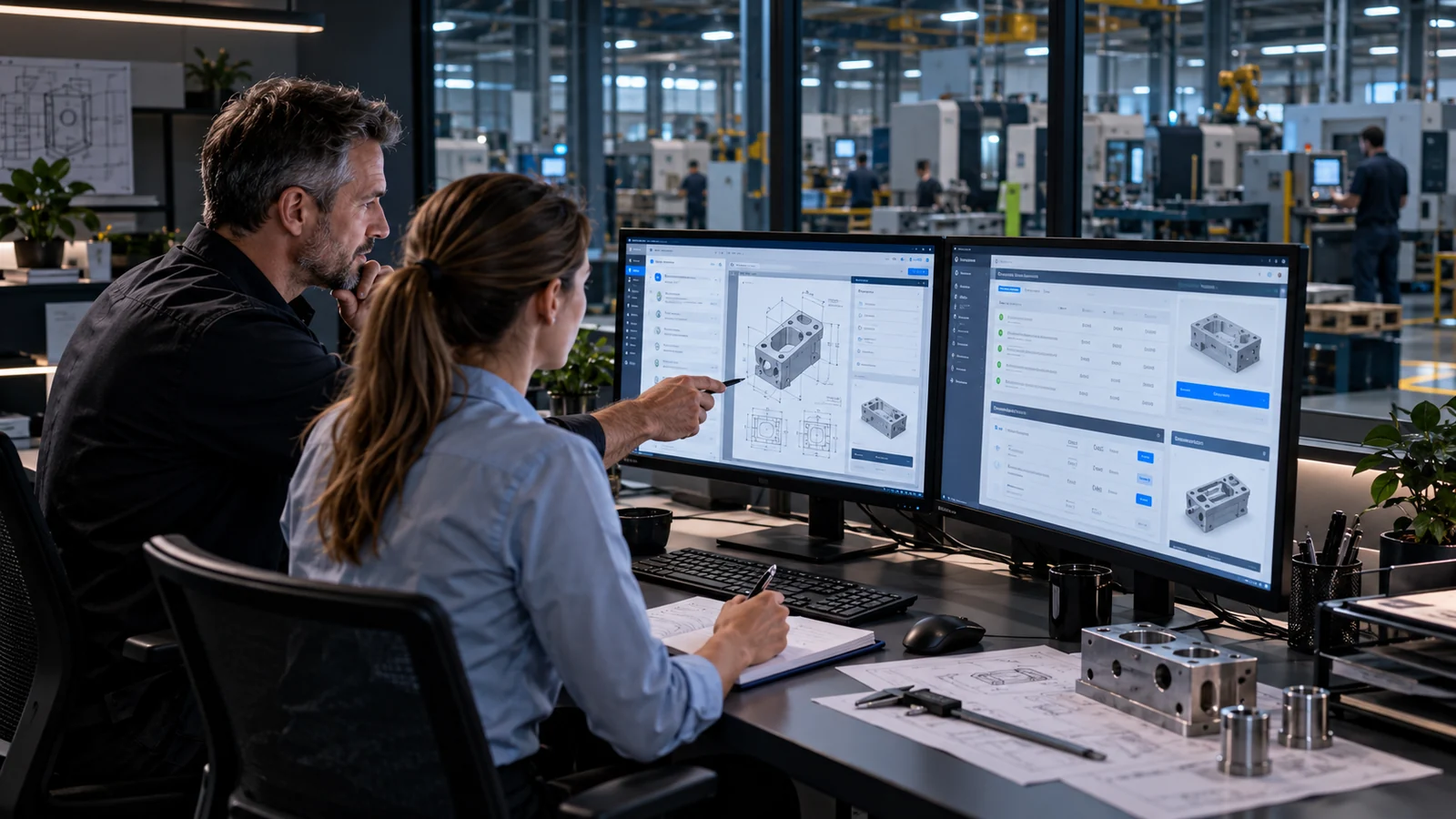
Analysis & pilot
Understand processes, identify goals and bottlenecks, and choose a sensible starting point.
Digitize the core process
For example, put inquiry/quote, planning, production or warehouse into productive use first.
Add further modules
Add only the functions that are really needed.
Fine-tune & expand
Further develop interfaces, reports, roles, automations and industry logic.
Show us your real workflow.
The best starting point is a real process: incoming inquiries, documents, systems, decisions, machines, material and today’s time effort. From this, you can derive where automation offers the greatest leverage.
Typical start
- Map the process
- Identify time wasters and media breaks
- Select modules and integrations
- Pilot with real data
- Expand step by step
What companies want to know before getting started.
Do ERP and existing systems have to be replaced?
No. secondFactory complements ERP, CAD, warehouse/WMS, machines and other systems instead of replacing them. What works well stays; data is imported and selectively written back. More: connecting existing systems.
Can we start with a single module?
Yes. Implementation starts with analysis and a pilot on a real process. Then a core process – for example inquiry/quote, planning, production or warehouse – goes live, and further modules are only added when they are needed.
Can it run on your own servers?
Yes. secondFactory can be operated on-premises or in a private cloud; AI functions can run locally if production know-how is to stay within the company. Details: security and operating models.
Who approves results?
Your team. secondFactory prepares; at defined points, a person deliberately confirms, corrects or approves – nothing slips through unnoticed. More: the control principle.
What does the implementation effort depend on?
On the scope of the process, the selected modules and the systems and machines to be connected. This is exactly what the process analysis clarifies – resulting in a realistic implementation plan.
What is needed for the process analysis?
A real workflow from your operation: intake, documents, systems, decisions, machines, material and today’s time effort – for example emails, documents and the path of a typical order.
The best starting point is your real process.
Show us emails, documents, systems and the path of a typical order. From this, we develop a realistic implementation plan.