
Less routine time. More capacity.

50–80% less processing time for suitable recurring workflows.

The goal of secondFactory is not “more software”, but less unnecessary work. Where processes are recurring, rule-based and backed by sufficient data, the system takes over large parts of the preparation and downstream processing. Employees review, correct exceptions and approve.

50–80%typical target potential for suitable routine workflows
Capture oncethen reuse the data throughout
Less rebuildingfor quotes, costing, CAD/CAM and documentation
More expert workinstead of searching, typing, transferring and standard repetition
Where time is lost today

Repetitions, handovers and media breaks cost capacity.

Office & sales

Reading inquiries, transferring data, searching for missing information, preparing costing data and compiling standard quotes.

Design engineering & CAM

Rebuilding similar models, defining machining strategies, selecting tools, generating programs, running simulations.

Production & logistics

Searching for information, asking about status, assigning documents, transferring feedback, manually maintaining delivery and quality records.

Manual today vs. with secondFactory

Routine shrinks. Expert work remains.

This is how the work shifts in a workflow with a high share of routine: the system largely takes over capturing, transferring, searching and standard preparation. Reviewing, deciding and handling exceptions stay with your team.

Manual today vs. with secondFactory – schematic representationTwo bars for a workflow with a high share of routine. Manual today: expert work plus full routine. With secondFactory: expert work unchanged; depending on the workflow, 20 to 50 percent of the routine remains, i.e. 50 to 80 percent less routine time. Schematic, no measured values.Expert work: review, decide, resolve exceptionsRoutine: capture, transfer, search, prepare standardsRange depending on workflowtime gained for expert work and additional ordersManual todayManual today – expert workExpert workManual today – routine: fully manualRoutineWith secondFactoryWith secondFactory – expert work: unchanged with the teamExpert workWith secondFactory – remaining routine: at least 20%RestRange depending on workflow: 20–50% of the previous routine time remainsdepending on workflowTime gained: at least 50% of routine timetime gained50–80% less routine time (target range)Schematic representation of a workflow with a high share of routine – no measured values.The specific potential is measured during the process assessment on the real workflow, before and after.Manual today vs. with secondFactory – schematic representationTwo bars for a workflow with a high share of routine. Manual today: expert work plus full routine. With secondFactory: expert work unchanged; depending on the workflow, 20 to 50 percent of the routine remains, i.e. 50 to 80 percent less routine time. Schematic, no measured values.Expert work: review, decideRoutine: capture, transfer, searchRange depending on workflowtime gainedManual todayManual today – expert workExpert workManual today – routine: fully manualRoutineWith secondFactoryWith secondFactory – expert work: unchanged with the teamExpert workWith secondFactory – remaining routine: at least 20%RestRange depending on workflow: 20–50% of the previous routine time remainsTime gained: at least 50% of routine timefreed50–80% less routine timeTarget range, depending on workflowSchematic view of a workflowwith a high routine share – no measured values.Measured on the real process.
Manual today vs. with secondFactory – schematic, no measured values.
Show as table
WorkflowExpert workRoutine
Manual todayentirely with the teamfully manual
With secondFactoryunchanged with the team20–50% of the previous effort – i.e. 50–80% less (target range, depending on workflow)

Schematic representation, no measured values. Measured on the real process, before and after.

The entire process

From inquiry to delivery: automate routine, review exceptions.
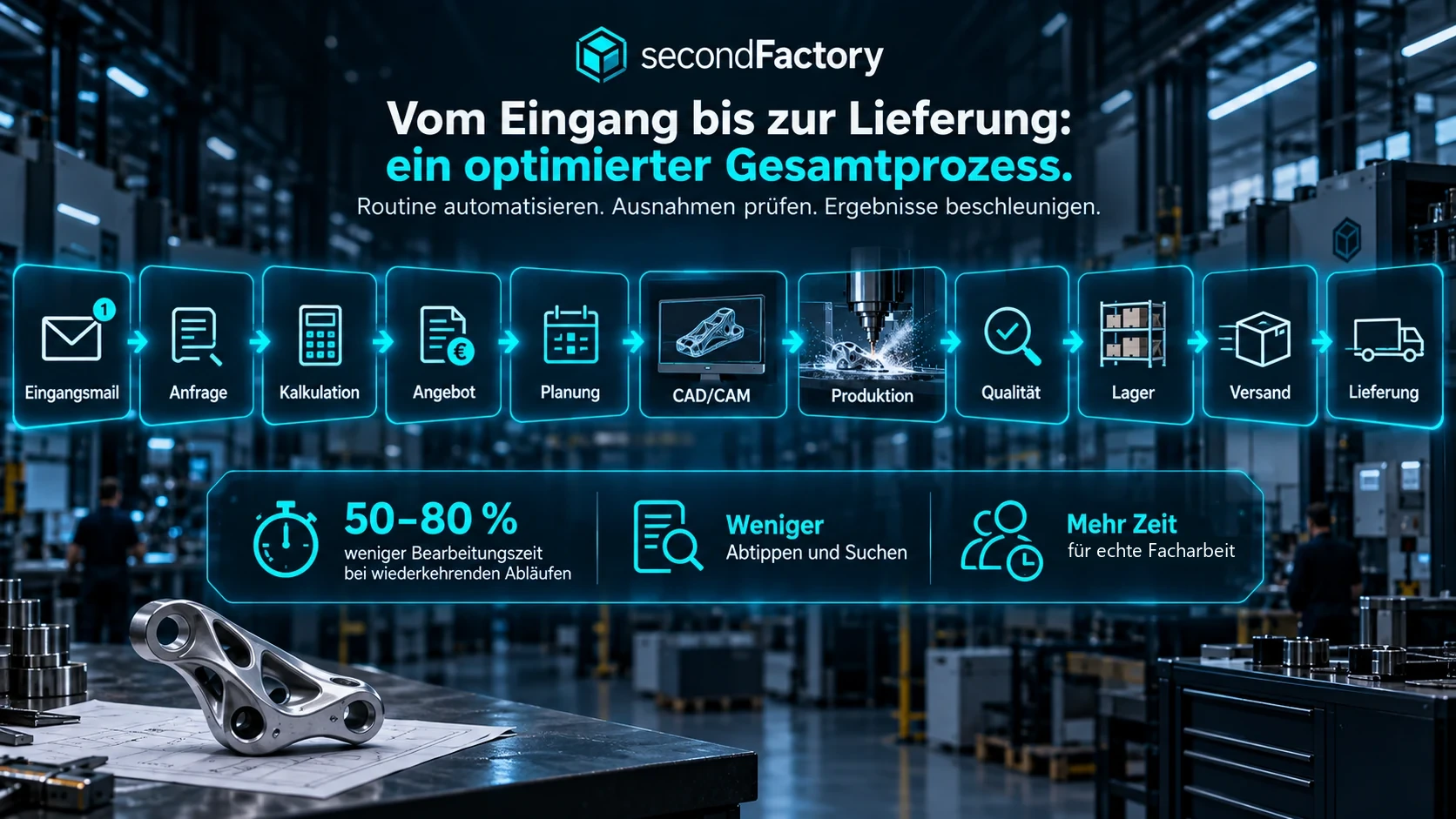
From inquiry to delivery: an optimized end-to-end process
Graphic: eleven stations from the incoming email to delivery; 50–80% less processing time for recurring workflows.
Important: no blanket promise

The potential is measured on the real process.

50–80% is a target range for suitable recurring work steps, not a guaranteed result for every process. The decisive factors are data quality, variants, approval rules, system access and the share of genuine expert decisions. That is why secondFactory starts with a process assessment and measures the effort before and after.

01Record actual time
02Determine routine share
03Automate
04Define approvals
05Measure time saved